









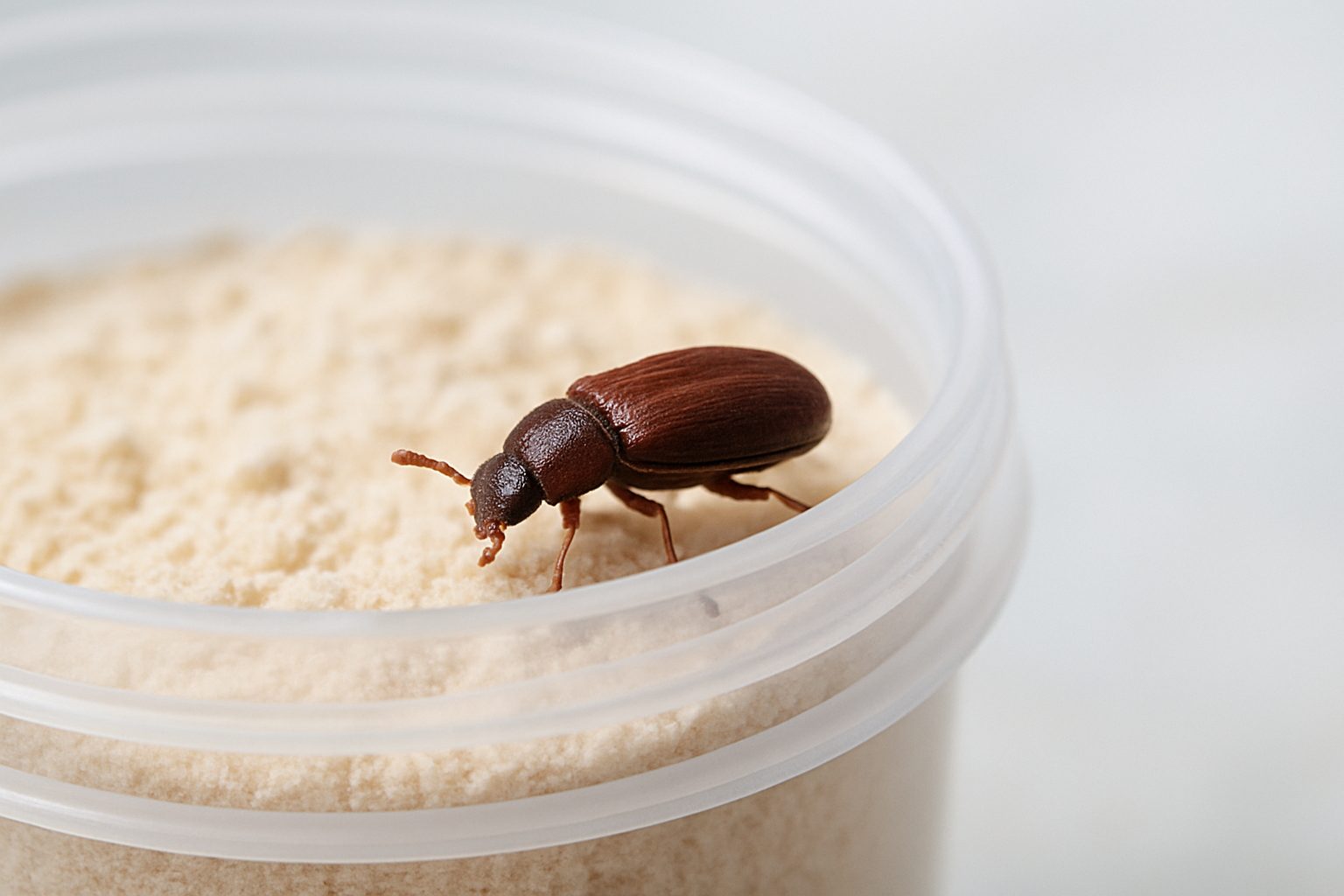
Most people discover they have a tobacco beetle problem not by finding larvae in their food, but by spotting a few small brown beetles flying near kitchen lights or dry goods storage. The insect is easy to dismiss at first glance—it’s tiny, fast-moving, and looks like any other common bug. But understanding Tobacco Beetle Control (菸甲蟲防治) early is the difference between a manageable situation and one that keeps cycling back no matter how many times you clean.
In This Article
- What Exactly Is a Tobacco Beetle and Why Is It So Hard to Eliminate?
- Where Do Tobacco Beetles Come From?
- Which Areas of a Home or Warehouse Are Highest Risk?
- In residential settings, high-risk zones include:
- In warehouses and commercial feed areas, the risk expands to:
- Why Doesn’t Spraying Alone Solve a Tobacco Beetle Infestation?
- What Are the Most Effective Steps for Residential Tobacco Beetle Control?
- Step 1: Audit All Stored Dry Goods
- Step 2: Remove Contaminated Items Promptly
- Step 3: Deep-Clean the Affected Storage Zone
- Step 4: Transition to Airtight Containers
- Step 5: Control Environmental Conditions
- Step 6: Monitor for Several Weeks After Treatment
- How Should Warehouses and Feed Storage Areas Approach Tobacco Beetle Management Differently?
- Do Tobacco Beetle Traps Actually Work?
- When Should You Call a Professional Pest Control Service?
- Frequently Asked Questions About Tobacco Beetle Control
- Does a tobacco beetle bite humans?
- Can tobacco beetles infest a clean home?
- How long does it take to fully eliminate a tobacco beetle infestation?
- Are UV light traps effective for tobacco beetle monitoring?
- What is the single most important step in tobacco beetle control?
Lasioderma serricorne, commonly known as the cigarette beetle or tobacco beetle, is recognized globally as a significant stored-product pest. It doesn’t just target tobacco. Dry foods, spices, herbs, dried plant materials, pet feed, and a wide range of shelf-stable commodities are all fair game. That’s why this pest appears in households, retail environments, warehouses, and feed storage areas alike.
This guide addresses the most frequently asked questions about tobacco beetle behavior, infestation patterns, and evidence-based control strategies—so you can approach the problem methodically rather than reactively.
What Exactly Is a Tobacco Beetle and Why Is It So Hard to Eliminate?
The tobacco beetle is a small, oval-shaped beetle with a reddish-brown appearance. Adults typically fly at night and are drawn to dark, undisturbed areas. The real challenge with this pest is not the adult you see flying around—it’s the eggs, larvae, and pupae hidden deep inside packaging and storage materials.
By the time adult beetles become visible, a population has often been developing in a concealed location for some time. The life cycle from egg to adult accelerates under warm, humid conditions, which means infestations can escalate quickly if environmental factors are favorable.
This explains a common frustration: people spray for visible beetles, the numbers drop temporarily, and then new adults emerge days later from untreated packaging. The surface gets treated; the source does not.
Where Do Tobacco Beetles Come From?
The most important thing to understand about how tobacco beetles enter a space is this: in most residential cases, they are brought in, not flown in.
Contaminated goods arriving from suppliers or retailers are the most common source. By the time a product reaches your home or storage facility, it may already carry eggs or early-stage larvae embedded inside the packaging. This is why even clean, well-organized spaces are not immune.
Common entry vehicles include:
Large bags of pet feed or animal fodder
Bulk-purchased spices, herbs, or dried teas
Traditional medicine materials and dried botanicals
Baking ingredients stored for extended periods
Snack foods in original packaging left undisturbed for months
Cardboard boxes used for long-term dry goods storage
Once inside, the beetle doesn’t need much to thrive. A dark cabinet, an open bag, a warm corner—these are enough to sustain a reproducing population.
Which Areas of a Home or Warehouse Are Highest Risk?
Tobacco beetles prefer environments that offer food, shelter, warmth, and minimal disturbance. They are rarely found on open countertops. The real hotspots are places that don’t get regularly examined.
In residential settings, high-risk zones include:
Dry goods and pantry cabinets
Spice and tea storage areas
Traditional herbal medicine storage
Pet food containers and surrounding shelving
Rarely opened snack drawers or baking material cabinets
Cardboard boxes stacked in storage rooms
Dried flower or potpourri displays
In warehouses and commercial feed areas, the risk expands to:
Raw material and ingredient racks
Pallet undersides and wall corners
Packaging material zones
Long-term storage areas with low turnover
Equipment edges and shelf joints where debris accumulates
A common oversight is focusing too much on visible surfaces while ignoring the deep corners of cabinets, the folds of bag openings, and the bottom layers of stacked goods. Tobacco beetle larvae stay inside the food source—they don’t announce themselves.
Why Doesn’t Spraying Alone Solve a Tobacco Beetle Infestation?
The life cycle of the tobacco beetle includes egg, larva, pupa, and adult stages. Conventional insecticide applications that target adult beetles do not reliably reach larvae and pupae embedded inside food packaging or tucked inside cabinet crevices.
Here’s what typically happens when the infestation source isn’t addressed:
Adults are reduced after treatment
A few days later, new adults emerge from previously untouched pupae
The assumption is that new beetles have entered from outside
The actual cause is continued development inside an overlooked package or location
Effective tobacco beetle control follows a sequential logic: identify the source → remove contaminated goods → clean the environment → improve storage → monitor consistently.
Pesticide application, where warranted, is one component of this process—not the entire solution.
What Are the Most Effective Steps for Residential Tobacco Beetle Control?
Step 1: Audit All Stored Dry Goods
Start where adult beetles appear most frequently, then expand outward to all nearby dry goods. Look for small puncture holes in packaging, fine powdery residue inside containers, unusual clumping, shed skins, or frass-like particles near bag seams and box corners.
Step 2: Remove Contaminated Items Promptly
Any item that shows signs of infestation should be sealed immediately and disposed of. Keeping it “to observe” extends the infestation. Before disposal, seal the item inside a bag to prevent adults or larvae from spreading during removal.
Step 3: Deep-Clean the Affected Storage Zone
Move all items out of the affected area. Use a vacuum to remove debris from shelf surfaces, joints, hinges, and gaps. Follow up with a wipe-down of all interior surfaces. Pay close attention to tight corners and sliding rail grooves where organic matter accumulates.
Step 4: Transition to Airtight Containers
Original product packaging—thin plastic bags, paper boxes, folded bag tops—offers minimal resistance. Transfer high-risk items into hard-sided airtight containers. This step both removes harborage opportunities and makes future inspections far easier.
Step 5: Control Environmental Conditions
Higher humidity accelerates tobacco beetle reproduction; cooler, drier conditions slow it. While residential spaces can’t be controlled with laboratory precision, maintaining dry, ventilated storage areas meaningfully reduces infestation risk.
Step 6: Monitor for Several Weeks After Treatment
Do not equate “no visible beetles today” with “problem solved.” Continue checking the same high-risk zones weekly. If monitoring traps are in use, track counts rather than individual sightings to assess whether the population is actually declining.
How Should Warehouses and Feed Storage Areas Approach Tobacco Beetle Management Differently?
Residential infestations are bounded by the volume of goods in one home. Commercial and warehouse environments carry a different challenge: high material volumes, irregular stock rotation, complex layouts, and low-traffic zones that are easy to overlook.
For these spaces, management must become systemic rather than reactive. Key practices include:
Separating new and existing stock to prevent cross-contamination
Implementing first-in, first-out rotation protocols
Scheduling regular physical audits of all storage zones, including wall corners, pallet undersides, and equipment edges
Documenting monitoring results to identify recurring hotspots
Establishing clear thresholds for when professional intervention is warranted
A single deep-clean is not sufficient for warehouse environments. Consistent protocols matter more than any one-time intervention.
Do Tobacco Beetle Traps Actually Work?
Pheromone-based monitoring traps play a well-documented role in tobacco beetle management—but they are monitoring tools, not eradication tools.
Research into tobacco beetle chemical ecology has identified serricornin as a primary pheromone component with demonstrated attractant activity toward male beetles. This scientific foundation has made pheromone traps a reliable method for detecting and tracking populations, particularly because the pest’s concealed habits make visual detection alone insufficient.
The practical value of monitoring traps lies in three areas:
Early detection before populations reach damaging levels
Identifying the zones with highest activity
Confirming whether control measures have been effective over time
Traps work best as part of a broader integrated approach. If the source material is still present, catching a portion of the adult population in a trap will not stop the infestation from continuing.
When Should You Call a Professional Pest Control Service?
Some tobacco beetle infestations can be resolved through diligent self-managed steps. Others warrant professional assessment. Consider professional involvement when:
The infestation keeps returning after multiple rounds of cleaning
The source cannot be confidently identified
The affected area spans multiple rooms, cabinets, or storage zones
The space involves commercial food storage, animal feed, or raw ingredients
The situation carries brand, regulatory, or food safety implications
Professional pest control adds value not primarily through chemical treatment, but through structured source identification, material assessment, zone-by-zone evaluation, and post-treatment monitoring protocols.
Frequently Asked Questions About Tobacco Beetle Control
Does a tobacco beetle bite humans?
Tobacco beetles do not bite or sting humans. Their harm is to stored goods—food contamination, product loss, and the cost of repeated treatment.
Can tobacco beetles infest a clean home?
Yes. Cleanliness reduces risk but does not eliminate it. A contaminated product brought home from a store can introduce an infestation regardless of how tidy the space is.
How long does it take to fully eliminate a tobacco beetle infestation?
Timeline varies depending on the size of the infestation and how thoroughly the source is removed. Monitoring should continue for a minimum of several weeks after initial treatment to confirm the population is declining.
Are UV light traps effective for tobacco beetle monitoring?
Research has shown that UV light elicits strong attraction responses in tobacco beetle adults across different populations, sexes, and feeding states. UV-based traps are used alongside pheromone traps in commercial settings as a complementary detection tool, particularly in larger storage and processing environments.
What is the single most important step in tobacco beetle control?
Finding and removing the infested source material. Every other step becomes more effective once the breeding site is gone.
What You Need to Know
- Tobacco beetles, known scientifically as Lasioderma serricorne, are significant stored-product pests that infest a wide range of dry foods and spices, not just tobacco.
- Infestations often go unnoticed until adult beetles are visible, as eggs, larvae, and pupae remain hidden deep within packaging and storage materials.
- Most tobacco beetle problems in homes originate from contaminated goods purchased from suppliers, rather than beetles flying in from outside.
- High-risk areas for tobacco beetle infestations include dry goods cabinets, spice storage, pet food containers, and rarely opened snack drawers.
- Conventional spraying for adult beetles alone does not resolve infestations since it fails to target larvae and pupae that are hidden in packaging.
- Effective control of tobacco beetles requires a systematic approach that includes identifying and removing contaminated goods, deep cleaning, and transitioning to airtight storage containers.